
Terrain markers
At SOILAB, we believe that soil knowledge is the foundation of good agricultural practice.
In this section, we present in a simple and understandable way the basic soil parameters – such as pH, electrical conductivity (EC), sodium, potassium, phosphorus, organic matter and other indicators.
With the help of explanatory diagrams and short professional notes, you can better understand what the analysis values mean, how they affect the crop, and what interventions may be required.
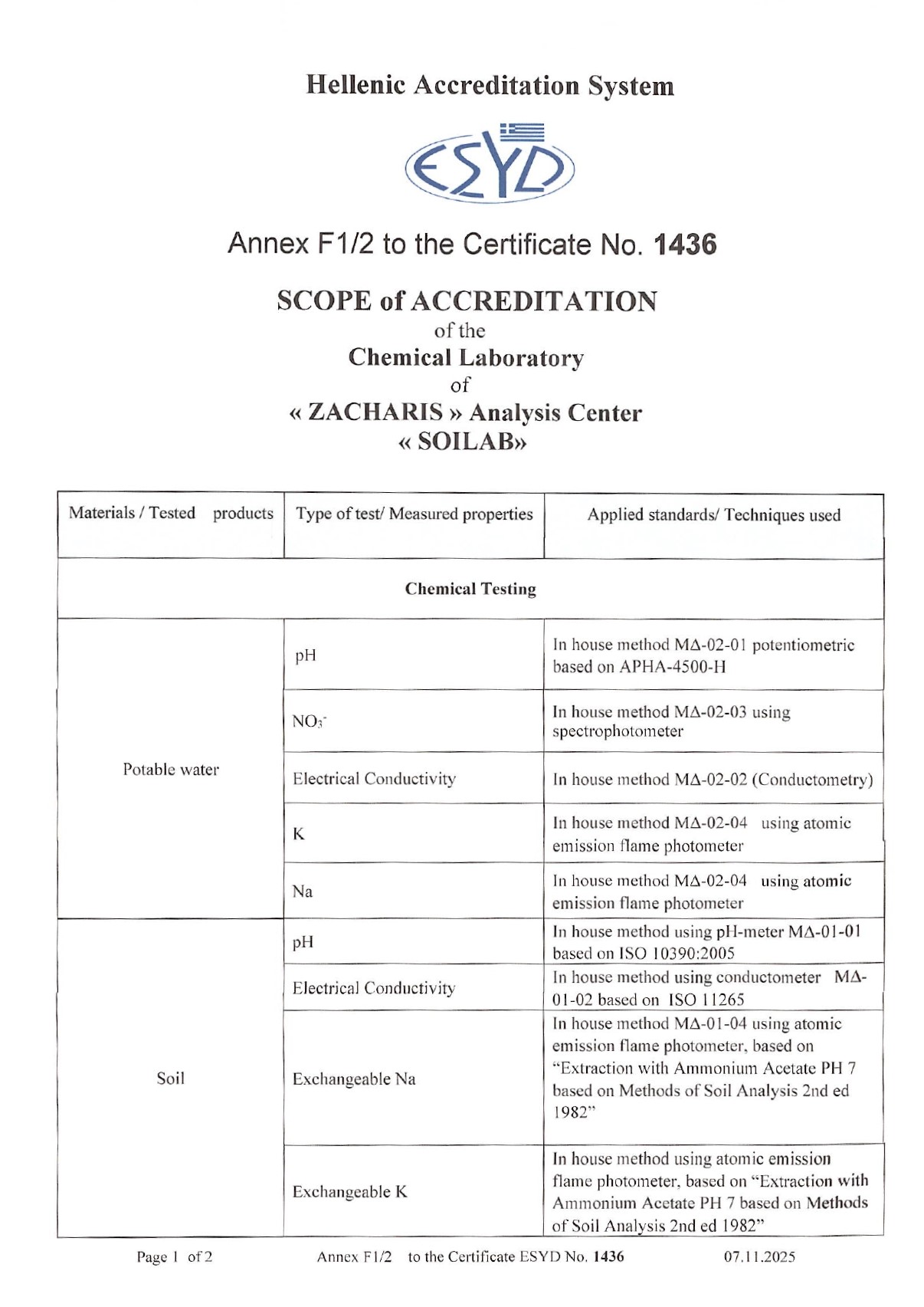
The data is based on scientific observations and the experience of our ISO 17025 accredited laboratory.
Soil pH Analysis:
What is it:
Soil pH is a fundamental parameter that indicates how acidic or alkaline the soil is.
Γιατί Είναι Σημαντικό:
PH affects:
- The availability of nutrients: At extreme values (very acidic or very alkaline), important elements such as nitrogen (N), phosphorus (P), potassium (K),
σίδηρο (Fe) κ.ά. είτε δεσμεύονται είτε εκπλένονται. - Microbial activity: The correct pH supports the action of beneficial microorganisms, essential for the degradation of organic matter and the release of nutrients.
- The structure and physical state of the soil: Through its effect on colloids and ions.
Ideal pH Ranges per Crop:
- Vegetables – Horticultural crops: 6.0–7.0
- Vineyard – Olive trees: 6.0–8.0
- Cereals – Industrial plants: 6.0–7.5
Price Interpretation:
PH Value – Interpretation – Recommendations
<5.5 – Too acidic – Liming required
5.5 – 6.5 – Acidic – Adapted fertilization
6.5 – 7.5 – Neutral / Ideal – Suitable for most crops
>7.5 – Alkaline – Possible deficiencies of Fe, Zn, Mn – need for specialized management
When to Check:
- Every 3–5 years, in permanent crops
- When changing cultivation or management
- When there are signs of poor growth or malnutrition

Soil Electrical Conductivity (EC):
What is it:
Electrical conductivity (EC) is the ability of a soil solution to conduct an electric current. It is directly related to the concentration of dissolved ions (salts) in the soil.
Why it is important:
– High conductivity → High salt concentration → Possible salinity affecting
negatively affect plant growth.
– Low conductivity → Possible nutrient deficiency or too well drained
terrain.
Typical EC Limits (in dS/m or mS/cm):
EC Value – Interpretation
<0.2 Very low – possible nutrient deficiency
0.2 – 0.8 Satisfactory for most crops
0.8 – 2.0 Moderate – caution depending on the crop
>2.0 High – risk of salinity
What affects EC:
– The quality of irrigation water
– Fertilizer applications
– Soil drainage and texture
– Natural salt deposits
At SOILAB:
The measurement is performed using ISO 17025 accredited methods, either in a saturation extract or in a 1:2.5 ratio, depending on the needs of the crop. We provide full interpretation and advisory support.
Using EC in practice:
- Diagnosis of saline or nutrient-poor soils
- Lubrication adjustment to avoid toxicity
- Monitoring the effect of irrigation water on soil quality

Soil Mechanical Structure Analysis:
What is it:
The mechanical composition describes the proportion of soil particles, namely sand, silt and clay. This particle size analysis is essential for understanding the physical structure of the soil and affects critical properties such as permeability, water retention, aeration and capacity.
συγκράτησης θρεπτικών στοιχείων.
Why it is important:
- It influences crop selection and farming practices
- Determines irrigation and fertilization needs
- Contributes to the design of improvement measures to improve fertility
- Provides information for long-term soil management
Soil Categories:
Mechanical composition classifies soils into categories such as:
- Sandy
- Sandy loam
- Clayey
- Clayey
- Clayey loams
Κάθε τύπος έχει διαφορετικές φυσικές ιδιότητες που επηρεάζουν την καλλιεργητική απόδοση.

Calcium Carbonate (CaCO₃) in Soil:
What is it:
Calcium carbonate (CaCO₃) is a natural calcium salt found in many soils, especially in areas with limestone rocks. It is the main component of
lime and largely determines soil properties, especially pH and nutrient availability.
Content categories (%):
CaCO₃ Content – Interpretation
<1% – Non-calcareous soil
1 – 5% – Weakly calcareous
5 – 15% – Moderately calcareous
>15% – Strongly calcareous to calcareous
How does it affect the soil:
- Increases pH (alkalization)
- Binds trace elements (Fe, Zn, Mn, Cu) → possible deficiencies
- Affects the structure and stability of clays
- May reduce phosphorus (P) availability
- Territorial origin and age index

Organic Matter Analysis with Soil Fertility:
What is it:
Soil organic matter consists of plant and animal remains in various stages of decomposition, microorganisms, and stable carbon compounds such as humus. It is critical for soil structure, fertility, and water retention.
Benefits of Organic Matter:
- Improving soil structure and increasing water retention
- Providing essential nutrients
- PH stabilization
- Support of microbial life
- Reducing corrosion
.
Optimal Levels by Cultivation (indicative):
- Vegetables: 3–6%
- Cereals/Corn: 2–4%
- Tree crops: 2.5–5%
- Cotton: 1.5–3%
Relationship with Irrigation and Fertilization:
Soil with high organic matter retains water and nutrients better, reducing the need for fertilization and irrigation. In addition, the absorption of nitrogen and phosphorus is improved.
Content Categories:
- Very Low: <1.5%
- Low: 1.5–2.5%
- Moderate: 2.5–4%
- High: >4%

Analytical Analysis of Nitrogen (N) in Soil:
What is it:
Nitrogen is one of the most important macronutrients for plant growth. It is a key component of proteins, nucleic acids (DNA, RNA) and chlorophyll, and actively participates in a multitude of biochemical processes that support growth, root system development, and crop yield.
Forms of Nitrogen in Soil
- Organic Nitrogen: It constitutes the majority of nitrogen in the soil, incorporated into organic matter (plant residues, microorganisms). It is not immediately available to plants, but is gradually released through the process of degradation and ammonification.
- Ammoniacal Nitrogen (NH₄⁺): Stable form that can be taken up by plants, but is easily converted to nitrates through nitrification.
- Nitric Nitrogen (NO₃⁻): The most common form of available nitrogen, easily absorbed by plants. However, it is susceptible to leaching, especially in light soils.
Important Factors Affecting Nitrogen
- Temperature and Humidity: They speed up or slow down the microbial processes that release nitrogen from organic matter.
- Soil pH: Ideal pH 6.0–7.5 supports optimal activity of microorganisms and stability of nitrogen forms.
- Microbial Activity: Essential for the decomposition of organic matter and the conversion of nitrogen into available forms.
- Cultivation Practices: The use of fertilizers, irrigation and cultivation affect losses (through leaching, aeration, absorption).
Importance and Effects
- Insufficient Nitrogen: Reduced growth, leaf chlorosis, limited yield.
- Nitrogen Surplus: Excessive vegetation at the expense of fruiting, increased risk of water pollution (nitrate pollution), nitrogen gas emissions (N₂O) with environmental consequences.
When to Perform Nitrogen Analysis
- Before fertilizing to accurately determine needs
- After heavy rainfall or irrigation that may cause leaching
- In areas with intensive agriculture or where large quantities of nitrogen fertilizers are applied
- For crops with high nitrogen needs (e.g. corn, cotton)

Phosphorus (P) Analysis in Soil:
What is it:
Phosphorus (P) is an essential macronutrient for plants, critical for root development, flowering, fruiting and energy processes (ATP, DNA). Although required in small quantities, its proper management is crucial for agricultural performance.
Phosphorus Properties:
- Low mobility in soil → difficult absorption
- It binds easily in alkaline (with Ca) or acidic soils (with Fe, Al)
- Problems from both deficiency and excess
Formats & Availability:
- Available phosphorus: It is measured by appropriate methods (e.g. Olsen or
Bray, depending on pH) - Bound phosphorus: It is not directly absorbable by plants, but can be "activated" with proper management.
Interpretation of Values (Olsen, ppm):
P Value (mg/kg) – Level – Recommendations
<8 – Low – Lubrication required
8 – 17 – Moderate – Monitoring, possible reinforcement
>17 – 25 – Good – Satisfactory proficiency
>25 – High/Excessive – Beware of environmental impact
Prices may vary depending on the type of soil and crop.
When to Check:
- Every 3–5 years, especially before basic fertilization
- In soils with a history of depletion or overfertilization
- Before the installation of permanent crops (olive grove, vineyard, etc.)

Soil Potassium Analysis:
What is it:
Potassium is one of the three essential macronutrients (N–P–K) and plays a critical role in plant physiology. It is not a structural component, but it regulates many vital functions, such as photosynthesis, sugar transport, stress resistance (drought, frost, diseases), as well as fruit quality and preservation.
Formats and Availability:
In the soil, potassium is found:
- In interchangeable form (available to plants – measured in soil
analyzes) - In unavailable/reserved form in clay minerals
- In the soil solution (short-lived, vulnerable to leaching)
The availability of potassium depends on:
- Soil type (particularly high in heavy clay soils)
- PH and clay and organic matter content
- History of fertilization and cultivation practices
Interpretation of Analysis Values:
- Low (<150 mg/kg): High risk of deficiency – fertilization required
- Moderate (150–250 mg/kg): Low level especially for annual crops –
παρακολούθηση - High (>250 mg/kg): Adequate – avoid overfertilization (depends on annual crop to achieve maximum production)
(Prices are indicative and depend on the type of crop and the
type of soil.)
When to Check It:
- Every 3–5 years, in combination with other key parameters
- In intensively cultivated fields or after rich productions
- Before fertilizer applications or changing the cultivation program

Sodium (Na) Analysis in Soil:
What is it:
Sodium is an element that is usually found in small amounts in most soils. However, in high concentrations, it can negatively affect soil structure and fertility, as well as plant growth.
Role and Effect of Sodium:
- Usually not an essential nutrient for plants, but some crops (e.g. corn, sorghum) can use it in limited quantities.
- High sodium concentrations cause salinity and sodic soils, which are characterized by poor structure, reduced water permeability and reduced cation exchange capacity.
- The presence of sodium in large quantities can lead to in bonding and compaction of soil particles, reducing aeration and increasing water permeability, resulting in a negative impact on root growth.
Interpretation of Sodium Values:
Na Value (mg/kg) – Level – Recommendations
<200 Low – Safe – Normal values
200 – 400 Moderate – Caution – Monitoring and management
>400 High – Problem – Immediate remedial action required
When to Analyze:
- In areas with saline or sodic soils
- In areas with intense irrigation activity, where there is a risk of sodium concentration
- When plant growth problems or poor soil structure are observed

Apparent Soil Density (Bulk Density):
What is it:
Bulk Density is the mass of dry soil per unit volume (g/cm³), including soil pores.
Why is it important?
- It reflects soil compaction or looseness.
- It affects the circulation of water and air in the soil.
- It is related to rooting ability and productivity.
- Necessary for calculating the concentration of elements per hectare (e.g. organic
carbon or nitrogen).
Typical values and interpretations:
Bulk Density (g/cm³) – Interpretation
<1.2 – Low – good structure, rich in organic matter
1.2 – 1.6 – Normal – typical for agricultural soils
>1.6 High – compression, reduced root growth
Practical Applications:
- Compaction assessment in heavily cultivated soils.
- Calculation of carbon/nitrogen stocks in the soil (in t/ha).
- Helps in planning restoration or enrichment interventions.

Stay in touch
Address
46 Theron Street, Volos
Phone number
2421 305698
Email address
soilabsa@gmail.com
